On Starting an Online Business with Minimum Investment

The world is full of people who were told time and time again that their dream was impossible. They chose not to listen.

There is a saying that every successful enterprise needs three people: a dreamer, a businessman and a son-of-a-bitch. The dreamer would use his boldness and creativity to come up with ideas (read: goals) that do not seem doable; the business person would turn them into plans and strategy, and the third guy would apply his expertise and perseverance to making all of that stuff come true.

If you believe that you have a little drop of each of the three in your character, you should give it a try: start a business of your own. The 21-st century is a perfect time to do this.

I made my first steps in doing business remotely around the year 2000; I was a poor teacher with a family to take care of, and I lived in a country that had just shaken off the burden of the USSR’s ideology and lifestyle, where even the word ‘business’ had somewhat different meaning from the one we are accustomed to now.

No need to say, I had absolutely no money to invest into it: I did not even have a bank account! But I was lucky to have a few friends — the people I could trust, who were very reliable and, like me, had no money — so we decided to invest our energy, time and talents into ‘starting up something (this was how we used to call our business then) that would work with minimum investment’.

A year later, our Something was working in full swing, providing services to dozens of people, growing fast, expanding and generating some income — a modest income, but sufficient for us to live on and continue developing the services. On the day of its first anniversary, we gave our Something a name.

Now, when I look back, I realize that it was successful because we started it wisely:

  • we did a good work of planning it at the very beginning;
  • as we had no money, we had to invest our time and effort: we shared responsibilities between us, so each of us knew what expertise and how much effort they had to contribute into the business;
  • we agreed to spend all income generated during the first 6 months from the day of the first sale into the development of the business (and it worked!)
  • we continued keeping initial pace of the business even after we started generating some income.

Today, if I had to start it all over, I would probably do most of the things the same way. I would only add a few things in order to shorten the setting up phase:

  • I would buy my first website with a simple shopping basket (in my case, we had to build the website, add the shopping module and do all the SEO part by ourselves);
  • I would start a wiser marketing policy (there are many ways to market a business for free before you start investing into marketing);
  • I would start developing useful connections a lot sooner than I did, so by the time my website is up and running, I would have a list of potential clients to come to with my services.

When you start a business online, the only thing you need to invest into is the website — or even a web page — that would have some space to announce about your business and a tool that would allow your visitors to make payments for your goods or services from this web page directly into your bank account. This is a way easier to setup than having to prepare a whole office or a store for accepting customers. This is why I believe that the 21-st century is a perfect time for doing business. If you have some money to invest, you may go to a web-studio and request to have your website (web page) developed. Then, if you really want your business to work, you will be learning a lot every day. So, running the site and developing the online business will be the same thing as doing it in real time but with minimum initial investment.

In my following post, I will share about the things which you need to know before you request the development of a website which is supposed to become your online store or office. Here, I just wanted to say that it is possible. Even if you have very modest funds to start with.

Planning Your Sell-from-Home Business

“Don’t find customers for your products, Find products for your customers” Seth Godin, a famous blogger

The process of selling products face-to-face away from a retail store location, a market or, currently, from the coziness of your home, is called direct sales. When you decide to start selling something for the first time, more often than not, you do direct sales, and your first buyers are your friends, family, and co-workers. Later, you will develop your customer base by getting referrals and marketing your business.

At this moment, when you are only beginning your sell-from-home journey, you must be sitting in front of your computer screen for hours, surfing through the Internet in search of information how to set everything up.

In a perfect world, every business process begins with writing a detailed, formal business plan.

In the real world, most of us are tempted to jump right in and start building business right away, because — well, it is quite clear why. Because we need to start making money. Now.

Still, some planning has to be done if you want to succeed. Here are a few ideas how to simplify the process of planning and how to turn the boring process into fun.

(1) Think over your business opportunities. Write down answers to these questions:

  • Why do my future customers need the product that I am going to sell? (In other words, what creates the demand for your product?) Eg.: In summer, people tend to buy more water, ice-cream, umbrellas, sun glasses, hats etc. because it is hot. In the coming summer, many people may have to work from their homes, so they will be needing things like fans, air conditioners, water filters, home ice-cream machines, etc. The reason of growing demand for these products is the fact that a big [part of population will have to adapt to living and working from homes.
  • What can you offer to your customers as a solution of their problem? (What can you offer your customers to satisfy their demand?

(2) Think about your target market. Who are your potential buyers? What do these people have in common? Write down your thoughts about it. Eg.: Women ____ (ages –, interests — , preferences — etc.); Men ____ (ages –, interests — , preferences — etc.)

(3) Who are your competitors? Who is also going to sell the same products to the people in your sector of interest? Eg. Retail stores? Online stores? Other home business owners? Your next-door neighbor?

(4) Funding needed. Again, it makes sense to write this down and have a good look at your figures. Eg. $3,5k to purchase a webpage with a shopping basket, set up payment options to receive payments, to buy some supplies and do a bit of marketing

(5) Sales and marketing. How will you let people know that you are starting sales of your product or service? If your sales channel is an online store, you’ll need to consider doing specific marketing activities — they are different from the marketing that real store owners do. Write down a few things like these, to keep them at hand for the future: Eg. Set up accounts on Facebook, Twitter, Instagram, learn about GoogleAds, guest blogging, newsletters, Twitter campaigns etc.

(6) Financial Projections. This is the part of planning that everyone likes doing. Try putting this on paper:

  • Plan your sales for the nearest month; 6 months; 1 year; 2 years
  • Plan your expenses for the nearest month; 6 months; 1 year; 2 years
  • Plan your profit for the nearest month; 6 months; 1 year; 2 years

(7) Think about your milestones. Do not forget to write down the dates — then your dream will start looking like a plan — and see how realistic they are. Eg.: June, 1: set up payment module on my webpage; June, 15: prepare first 100 items of the product for sale; June 16: start marketing the product via social networks and among friends, colleagues, etc.; July 1: sell the first 20 items

(8) Your team and key roles. Are you planning to do everything by yourself? Will it become a family business some day? Who is going to help you and how much? What will everyone be responsible for in your business?

Young entrepreneur, teenager business owner work at home, alpha generation life style. checking parcel for deliver

(9) Partnerships and resources. Who can you attract to assisting you in developing your business? Will you need someone to deliver your goods to customers? Are you thinking about using a photographer to take beautiful pictures of your product items for your website? Will you need a packing service or any wrapping materials to buy for your sales process? Write down every item that you can think of and see which of these services/items you can get for free and what will require expenses. Decide who you can partner with in these areas and start negotiating with those people beforehand.

Well, your business plan is not something stable and done once and for all. You will need to work on this document all the time. Set a rule for yourself to look through your plan every morning, especially now, when you are setting everything up and learning a lot. The first week it may be a bit stressful, but as soon as you get into a habit of working with your biz plan daily, you will see that it helps you. It helps you to remain on track. It shows you the direction to go. Finally, it makes you feel more confident, which is so important for your future success.

“What Can I Sell with My Sell-from-Home Business?”

“Care enough to create value for customers. If you get that part right, selling is easy.” Anthony Iannarino, B2B Sales Coach

Since February 2020, online shopping has been developing at amazing speed and has actually managed to beat offline general merchandising stores (department and other non-specialized big-box stores). With so many people trying to minimize their exposure to the outside world, this trend is likely to get supercharged in 2020.

While things like groceries, household goods, medicines, health, beauty and personal care products have been resistant to the digital economy because many people still feel more comfortable picking them out in person rather than trusting the web, other groups of products like electronics and books are already purchased online as often as not. Now, a prolonged period of social distancing and quarantines may go a long way towards convincing people to try the web when buying groceries or shampoo.

Today — and day after day this tendency seems to mature — all businesses and all service providers tend to secure themselves by going online. Even those few lucky guys to still have their doors open to visitors. This whole quarantine thing has given a powerful push to moving all kinds of human relations toward online interaction.

As I spent decades of my life working as a university teacher, researcher and academic books author, I have met thousands of people who never did any kind of business and never believed they could do some. Today, when another crisis has slammed into our lives and smashed whole industries, millions of people who were used to working hard for salary have found themselves overboard, paddling helplessly, not knowing what to do.

So I have been hearing questions, like “Who will employ me now?”, “What shall I do without my office?”, “Learning a new set of skills? Hmm, isn’t it too late for me?”

People tend to develop a habit of doing things again and again: they feel comfortable and protected this way. As soon as the habitual rhythm is broken, many of us start feeling lost. This year, quite all of a sudden, the habitual pace of life was broken for millions of us. People have to rethink their occupations and general lifestyles.

Those who are familiar with doing sales from real offices and stores, as well as those who never did anything of the kind, are ready to try going online: they have no other choice! Their uncertainty often comes out in the same thing they say: “Okay, suppose I set up an online store.. what’s next? What can I sell from it?”

This is the place where our epigraph should go. Anthony Iannarino’s words about creating value for the customers are the roadmap for every beginner in online sales.They mean that one needs to find something — no matter, goods or services — that their potential customers would value and desire to own.

The easiest way to approach this decision would be to look around and ask yourself a series of questions:

  • Which of my skill(s) and knowledge can I share with people to satisfy their needs? (Think well, make a list);
  • What do people around me need most of all today? Which products or services are they eager to buy? (Think well, make a list);
  • Which items in my list are the same or somewhat similar to the list of people’s needs that I just created?
  • Do I have access (at least potentially) to any of these products or services? (Write them down and select the one that seems the least time/effort consuming to you);
  • How much effort/time/investment may it take me to set up an occupation of providing this product or service to people? (At this point, your thinking game will begin to turn into a plan);
  • Which category of people will appreciate my assistance in the first place? (Now, it will begin to turn into a business plan);
  • Here, at this step of creating your plan, I would suggest you to take a break and return to the beginning of this list. After the time break, go down it again and see if your have come up with new ideas or new items in your lists. It is always good to double check. Then, you can go forward with more confidence.

If your notes look well to you after double check, you will begin to notice that actually, business opportunities are everywhere. You only need to be motivated enough to go all the way from seeing them to making them work in your favor.

Suppose, you know that people in your area often complain about having to travel too far to buy fresh bakery for breakfast. With your online store, you could set up a system of bakery delivery requests, where your neighbors would send you requests for bakery delivery, and your only business would be to check your system for requests every evening and forward them to the bakery store, which would take care of the delivery in the morning. At first, your income on every request will be minimal, but the advantages of doing business online are evident:

  • You can do it from home or from anywhere, just keep your laptop or phone at hand at all times and don’t forget to connect to the Internet;
  • It won’t require as much of investment as a real store or office would;
  • You will always have some time left for your family and other businesses;
  • If you set up agreements with other stores and services and if you take effort to market yourself and get many people to visit your site, your income with grow with each service you provide.

This was just an example, probably not a very convincing one… but my main idea was to show you that you need to understand what people around you value most of all at a certain moment of time.

People’s preferences differ. At one moment they need beautiful clothes; in other times all they can think of is food; some want their purchases delivered right to the door; others need to request a consulting or classes online: all their desires and needs present opportunities for a business-thinking person.

Well, in 2020, the truth of life sounds contradictory, but this is how it is:

If you want to feel solid ground under your feet, go virtual! Go online!

Let us see what the coming summer will bring us. Hopefully, by that time you will already have your online business set up and going.

Set up Your Online Business in a Week!

“Business opportunities are like buses, there is always another one coming.” Richard Branson

Richard Branson has a unique talent of explaining complex things in a simple way, don’t you think? Looking at his quote, one is ready to believe that catching business opportunities is as easy as catching a bus. Well, every business requires a lot of thinking, planning, effort and investment — if we asked Richard Branson, he would tell us a lot about it. But this post is not about Branson’s approach to business, it is about the first steps that one needs to take today, in the 21st century, if they want to “catch their bus”: in other words, if they want to catch a new business opportunity.

Today, when many of us are looking for ways to start making income online, I am glad to share about an opportunity that my company offers: you can have an online store set up for your business in only one week!  Having an online store would prepare you to catch up with the complex reality of life: the whole world is going online, people adapt to working remotely; services and goods are available as before, but… they are provided distantly!

The process is fast-moving, and it is irreversible. The owners of physical offices and stores are facing the fact that it is no longer profitable to keep their premises. At the same time, the businesses that already work online, are having much better times these days.

How can you catch up with the fast pace of reality? Well, the only answer is- start an online business, too! And take effort to learn how to operate it. Luckily for many newbies, many of those who have online stores or businesses are quite reluctant about learning how to promote them. If you try herd, you have all the chances to win the race. This will be your bus to catch. Just set a goal, set it up and hop on!

Well, these are the five simple steps that my company, CHI Software, offers to those who are ready to set up an online business.

If you already own a website, we can connect a payment (or/and delivery) module to your existing website; If you don’t,

We can set up a whole online business (or store) for you, and you can have it just in one week!

I won’t go deep into details here, but the idea of the service is this:

1) We meet in a chat: we discuss your needs; you answer a number of questions which will help us understand all details and peculiarities of your particular business;

2) Based on this discussion, we make you an offer and sign an agreement of services;

3) As soon as all terms and conditions have been setup, we start working and you remain in touch with us;

4) When the work is finished, we show you the result and meet you online to demonstrate how everything works;

5) You start using your new system of online sales. From this moment and during the forthcoming month, we remain in touch with you to assist you with site operations, marketing of your online services and general orientation in online sales.

Interested? Please, send me a message or email me to: iryna.tymchenko@chisw.com; I will gladly share more details and connect you with my colleagues.

setup and build your business
setup online business and start making sales in a week!

Starting a Sell From Home Blog

This photo is a joke, it is nothing more than my little attempt to make you smile and remain optimistic through this time of uncertainty and stress.

Staying indoors may be quite hard to many. Millions of people never had such experiences before, and having to adjust to the work-from-home rhythm is quite stressful to them.

Working from home is not new to me, as is working online, but MAKING A LIVING by selling online is a different thing. It involves quite a lot of positive energy, patience, learning and perseverance. This is why I decided to start putting down and sharing my experiences of working from home as a salesperson. Let us see what it is like.

Please, leave your comments and share your experiences with me. Let us go through this uneasy time together… and win!

Job Interview Tips: What to Do When You Don’t Know How To Answer a Question

Everyone is nervous in a job interview. Everyone is afraid to hear a question to which they would have no answer. To some of us, the fear of embarrassment can be so bad that we prefer not to go to an interview at all. This little post is for those who are trying to train themselves against having moments of uncomfortable silence in communication.

First of all, it is good to avoid awkward silence in every piece of communication, not only in a job interview. The same can be said about speeding up and starting your answer before your partner could finish asking the question. As a teenager, I struggled quite hard with shyness, and I remember reading somewhere that, during a one-on-one conversation, the most “comfortable” time of silence between two people’s words is the time which you would need to pronounce the phrase twenty two. Since then, I often say twenty two in my mind whenever I am about to answer a question. It also helps, by the way, to overcome nervousness when I have important conversations.

So, the rule number one in an important situation like a job interview is not to panic and take your time. No matter how tricky, unusual or complex question you just heard, take a one second long pause to fill your lungs with air and say some words of general meaning — just to fill the air and to gain another few seconds to think over your answer.

This is a simple technique, but it should be trained. Try it a number of times in less important conversations before you bring it to a job interview. Do it like this

Question___(‘twenty two’)___Your answer

Having a few phrases of general meaning at hand at all times is also a good thing: just saying something like “Oh, this is an interesting question. In fact, I never looked at the problem from this standpoint…”

Then, quite logically, you might want to start thinking aloud. Imagine that you are doing exactly the thing that the interviewer asked you about and try to describe how you would do it. This will gain you a couple more seconds, and this will be some kind of an answer — not just silence on our part.

The next great conversation technique is to redirect the topic to an area in which you are more professional. If you manage to overcome nervousness, you will be able to do it, no doubt. Even if your answer will be a little not to the point, it is still better than sitting in complete silence. In an interview, you might want to say something about being very excited about the position you are interviewing for and explain how your previous experiences could help you do this new job really well.

Having a so-called fail-safe answer at hand in an interview is also a good technique: the interviewer will certainly notice your trick, but they will see that you are capable of dealing with various situations, and it will certainly work in your favor. Say something like: “I’m not familiar with this concept yet, but I’m really excited about learning and growing more professional in (your topic), so I’ve been actively trying to learn more. When I become a part of a working team, I will certainly learn a lot faster, because I’ll be learning on particular examples in a particular professional environment.”


Above all, it is good to learn from every interview experience you have. Regardless of what question you hear, never forget to consider what the hiring manager is really expecting to learn from the question. You may not be able to answer the actual question, but if you’re able to show yourself as an experienced communicator and if you give the hiring managers the information they are trying to learn with their questions, you will certainly produce a good impression and your chances for success will become higher.

Writing a Book Can Change Your Life

In my case, this statement is true. English for Your Job Interview is changing my life. When I started writing this book, my only idea was to assist young people in preparing to speak in their English job interviews, but as soon as the book saw the world, it started attracting new people into my life. Before I could realize it, I acquired a new status of a career coach — I had been one for a long time, but after I publishes the book, it somehow became ‘official’!

Today, I’ve been actively working as a career and effective communication coach; companies keep requesting my workshops and masterclasses, and all this due to the book, which, in fact, is not even about career coaching!

These days, I am working on the program of a new training, I am calling it C.C.C.: Customer Communication and Correspondence. I must make it a success, so I’ve been working really hard, thinking over every minute of my future presentation. I’ll share the description and the presentation here in my blog, as soon as the program is ready.

Engaging Your Audience

I found Anna in an empty connecting corridor between the two administrative buildings of the university. When she saw me, she threw herself on my shoulder and burst into tears.

“I swear I did my best to prepare,” she sobbed. “I worked on that presentation all week after the previous time, when they looked quite satisfied, and… this time the room is empty! Can you believe this? No one’s come to the training! No single person! They were all there a week ago, and today… oh, what did I do wrong?” Through sobbing, she nodded to thank me for a tissue and mumbled into it, “I’m not good at it, I’ll never do trainings again.”

That afternoon, for the first time in her life, Anna faced the fact that knowing a topic in and out does not guarantee success to a speaker. She also learned that, when you work with audiences of mature, ambitious, self-confident professionals, you’ve got to be just like them, plus you’ve got to produce a great first impression.

Just like a first date aftertaste can influence the whole relationship, the success of your coaching (training, lecturing, or any other kind of teaching) largely depends on how well you manage to impress your in the very first minutes of your presentation.

Here is an interesting thing: when you work with an audience of highly skilled professionals, they don’t expect to learn a lot from your training. They aren’t looking to dive into the depths of smart thinking; they are rather willing to watch your performance (your speaking manner, style, appearance, etc.) and to have the fun of enjoying (or criticizing) your occasional ingenious remarks. In other words, they come looking for entertainment. They want eccentricity. They are hoping to fall in love with your presentation, no matter what you are going to say there, and if you manage to meet their expectations, you are going to face success. Guaranteed.

The smart, highly skilled professionals can learn something new from books, but if they want to transfer their knowledge to others, they need to watch your performance and learn from a real life performance example.

Therefore, the number one task of your presentation is not to deliver information (the participants can find a lot of valuable information on the Internet and in books), but to create a certain emotional environment, and this environment is the reason why they have come to listen to you.

Please them. Please your listeners in the very first minutes of the meeting. Tell them an interesting fact, a joke, an anecdote, a quote, or a story. It should be related to your presentation, of course, but do not reveal that connection right away; the smartest thing would be to mention that joke (quote/statement/etc.) in the end of your presentation again and explain its connection with the topic of the meeting.

As an option, you can find some impressive statistics; compare some numbers, talk about facts, provide a couple of real life examples. And again, mention it in the end when you are summing up your presentation.

Another great way to begin your presentation would be to tell a story that starts with the words: “On my way here this morning, I…”

As an option, you could demonstrate them a practical skill (how to tie shoe laces with one hand or how to make a boiled egg slip into a bottle without touching it — anything that could impress your listeners)

As you speak, it makes sense to repeat your key message a few times during the training. Not to mention the fact that there must be a key message in every public performance.

Sharing a personal experience is a good method to attract attention of the audience. A first-hand story always sounds more attractive than any piece of information which has absolutely no relation to your life. A few other techniques that might help are —

  • to point our something about the audience or the current setting;
  • to show a compelling visual image and ask them to discuss it;
  • to ask a provocative question; or simply
  • to state an amusing, or remarkable fact.

If you want your audience to participate in what you are sharing, do not expect them to do this from the very fist minute. Warm them up by asking a few questions which do not have to be answered by the audience. Little by little, they will become more active and responsive.

Job Interview Was Too Short? That’s Probably a Bad News for You.

Oleksandr Shelegéda, currently a controlling specialist in financial services, is our interviewee at One on One column today. Oleksandr has 7+ years of experience in finance and change management. After obtaining a Bachelor’s degree in foreign languages and interpreting in Kharkiv Technical University, Oleksandr continued his education and obtained a Master’s degree in Project Management. One of his most memorable experiences is working for OSCE observing missions. To learn more about him, visit Oleksandr’s LinkedIn page.

Rina: How long have you been studying English? When did you first realize that you can communicate in it fluently and well enough to be able to live and work in the English language environment?

Oleksandr: I set off on my way of learning English when I was 6 y.o. It was in a small town in the Western part of Ukraine, in a small school, and with a new teacher every couple of years. There was more fun than learning in it to me. Probably, the first time I started to believe that I could speak and understand English was on the day of 9.11.2001. On that day, one of the TV channels was going live without translation and I was interpreting all that to my family.

Rina: Can you recall your first job interview?

Oleksandr: I’ve been on interviews since my University times so I can’t remember the very one. My personal attitude towards interviews in general is that you should go there quite often, just in case. Even if your job is good and you don’t want to change it in the next year. Just try to analyze the information you get there. This skill will only come if you practice a lot.

Rina: Of all the interviews you have been through, what question do you always find the trickiest and the most difficult to answer?

Oleksandr: Once you’ve had enough experience, everything becomes normal for you. You should never be afraid of saying no or I don’t know during interviews. The hardest thing for me now is to keep myself from laughing when I hear some old fashioned questions, like Where do you see yourself in 5 years? or What are your biggest strengths and weaknesses?

Rina: Have you ever had to answer absolutely unexpected questions that took you by surprise? How did you answer them?

Oleksandr: Sometimes recruiters would like to find a person with excellent knowledge of specific areas and they ask you questions out of your working field, like, What kinds of books for kids do you prefer? when you are applying to be an accountant.

Rina: Are you always nervous during the interviews? Does your emotional state during the interview affect your presentation in English? If yes, in what way? How do you prepare for your interviews every time when you get an appointment?

Oleksandr: I would say that it is normal to be a bit nervous before or even during interviews. To me, it really helps when I realize that I am also here to check how good is the company for me, and is it not only them who are in charge of the interview. Also, it always helps to think about possible ways of communication with interviewers beforehand. In this case, you will always have something to say and you won’t be scared.

Rina: How long do your interviews normally last? Do you feel more confident in the beginning or in the end of an interview?

Oleksandr: I would say that usually it takes from 30 to 60 min for a good interview. If it is too short, that’s probably a bad news for you. If it is too long, it may mean that the interviewers are nervous themselves or are unprepared, and then you can’t understand what are they looking for. You should probably forget about them and switch to other opportunities.

Rina: Can you remember any situations of using (not using) particular English words/phrases that influenced your communication with the interviewer? Were there any situations of misunderstanding because of misused words or mistakes made by you or by interviewers? Share any stories you can remember.

Oleksandr: It is always great when you know the necessary terminology in English. Sometimes it can also help when you give an explanation to the interviewers about a specific topic in order to sync with them. That helps in both ways – they can see that you know the topic, and you are not afraid that you are being wrong with your answers.

Rina: What is the best way to refresh your English communication skills before a job interview? How do you usually prepare for coming interviews? How much time does it usually take you?

Oleksandr: It is really hard to prepare yourself for this before the interview, especially when you have another job and the only time you have is a time for commuting between 2 locations. SO the only piece of advice here is to have a good rest on the night before the interview, and then to stay positive and fresh – that helps a lot.

Rina: Have you ever failed a job interview? If yes, what lesson(s) did you learn after it?

Oleksandr: It is not hard to receive a ‘no’ from recruiters. It is hard when they just ignore you and do not write back to you after the interview, not even a short message. Unfortunately, this may happen, so be prepared to send a note to them after some time if they don’t write back – and then, put them on your black list and try to forget about that interview, ASAP!

Sometimes, the recruiters provide you a feedback along with the rejection; it will help you to understand your weak points and to see what you need to learn for the future.

Rina: What kind of advice would you like to give to the young people who are about to have the first interviews of their lives?

Oleksandr: Lots of advice you can see above, so just to summarize a bit –

  • Don’t be too afraid;
  • Remember that you are going to that interview to take a look at the company and your potential manager;
  • Try to take some notes during interview, especially the names, and maybe some key questions;
  • Don’t be afraid to write back to them after a while if they never contacted you; and
  • Ask some questions, especially about general topics like their working atmosphere, their attitude towards working hours, and about payment, and about your possible colleagues and managers. This will help you make up your own opinion regarding the company.

Another Book Has Been Born

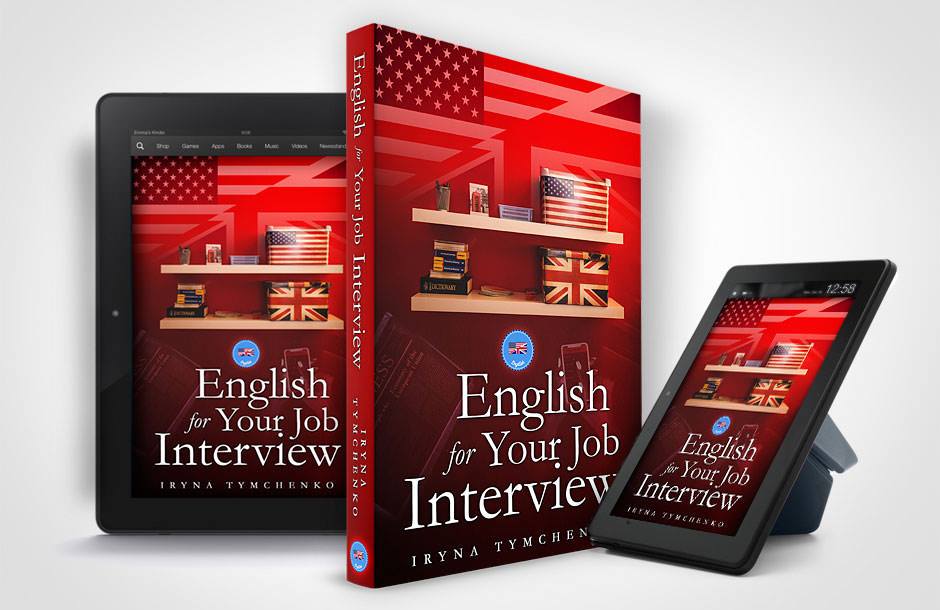
English for Your Job Interview

English for Your Job Interview is a preparation guide for a job interview in English. Its 51 units cover the most frequently asked interview questions and offer multiple training exercises and useful tips to help the job candidates communicate effectively with hiring managers during the interview.

The book is perfect for everyone whose English level is Intermediate or higher. It is indispensable for non-native speakers of English, who are seeking employment in international companies at the start of their careers.

Most importantly, English for Your Job Interview offers a way how to develop the skill of acting and communicating confidently during the interview. This book has already helped dozens of young professionals find their dream jobs.

  • Follow Share love. Educate. Inspire. on WordPress.com
  • New: English for Your Job Interview

  • Follow me on Twitter

  • An Interview

  • Recent: Romantic English Phrasebook

  • Recent: Romantic Russian Phrase Book

  • Languages & Lifestyles

  • Archives

  • Goodreads

  • 101 Books

  • Writing

  • Blogs I Follow

Shelf Love

live mines and duds: the reading life